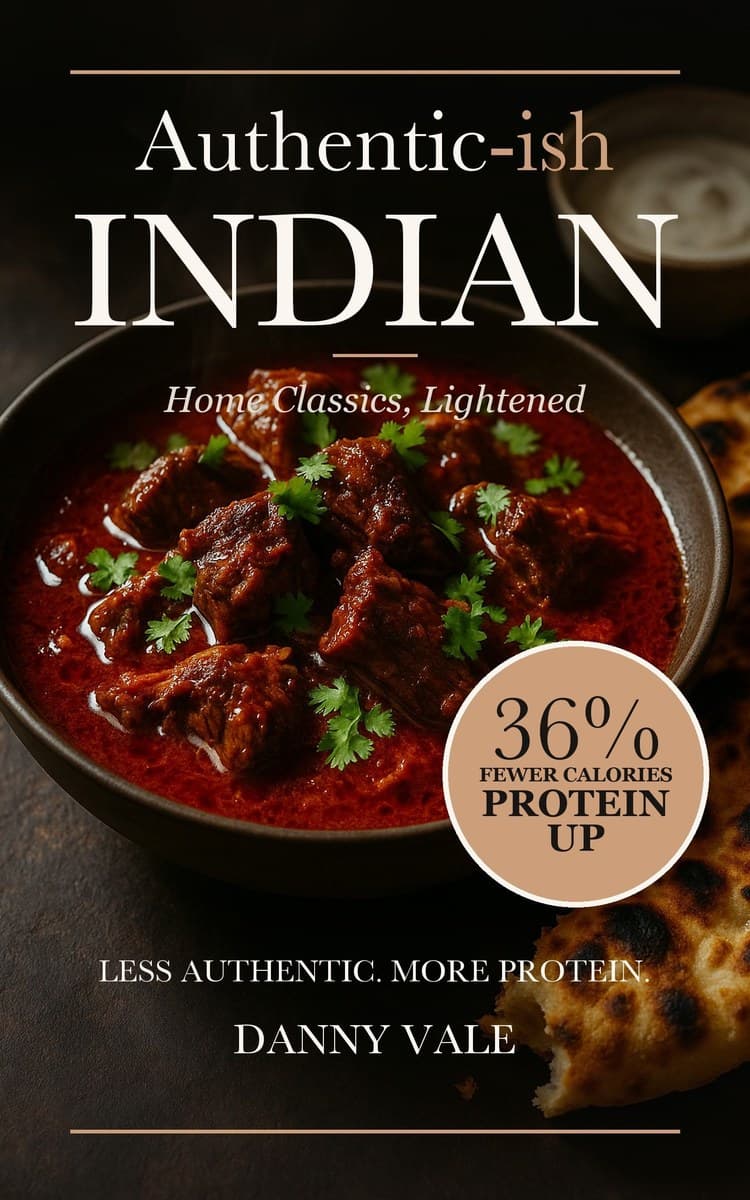
Butter Chicken, Chicken Tikka Masala and 53 more Indian classics, with the calories cut and the protein kept. 36% fewer calories on average, and every change costed.
Buy the paperbackKindle edition
What's in it
| Recipes | Chapters | Average calorie saving | Dishes rejected |
|---|---|---|---|
| 55 | 8 | 33% | 5 |
Every dish, and what came off it
Each figure is per serving, computed from the ingredient list. The traditional column is the real dish, not a strawman: it's costed from its own ingredient list so the saving is a measurement rather than a claim.
| Dish | Chapter | Traditional | This version | Saving | Protein |
|---|---|---|---|---|---|
| Chicken Tikka Masala | chicken | 618 kcal | 390 kcal | 37% | 44.8g |
| Butter Chicken | chicken | 762 kcal | 409 kcal | 46% | 51g |
| Rogan Josh | lamb | 781 kcal | 386 kcal | 51% | 46.1g |
| Chana Masala | dal | 502 kcal | 538 kcal | -7% | 26.5g |
| Saag Aloo | vegetables | 361 kcal | 188 kcal | 48% | 7.9g |
| Palak Paneer | vegetables | 707 kcal | 501 kcal | 29% | 38.8g |
| Chicken Korma | chicken | 643 kcal | 395 kcal | 39% | 54.2g |
| Lamb Bhuna | lamb | 647 kcal | 367 kcal | 43% | 43.4g |
| Aloo Gobi | vegetables | 399 kcal | 204 kcal | 49% | 8.1g |
| Samosa | starters | 335 kcal | 244 kcal | 27% | 14.2g |
| Tandoori Chicken | chicken | 562 kcal | 352 kcal | 37% | 61.3g |
| Chicken Biryani | rice | 955 kcal | 582 kcal | 39% | 42.5g |
| Vegetable Biryani | rice | 562 kcal | 441 kcal | 22% | 18.7g |
| Dal Makhani | dal | 497 kcal | 288 kcal | 42% | 20g |
| Prawn Curry | fish | 419 kcal | 315 kcal | 25% | 42.4g |
| Fish Curry | fish | 453 kcal | 305 kcal | 33% | 38.9g |
| Keema Matar | lamb | 528 kcal | 304 kcal | 42% | 31.6g |
| Chicken Jalfrezi | chicken | 422 kcal | 366 kcal | 13% | 48.6g |
| Baingan Bharta | vegetables | 301 kcal | 184 kcal | 39% | 7.2g |
| Chicken Madras | chicken | 598 kcal | 363 kcal | 39% | 42.5g |
| Lamb Vindaloo | lamb | 747 kcal | 376 kcal | 50% | 43.8g |
| Matar Paneer | vegetables | 817 kcal | 402 kcal | 51% | 24.7g |
| Chana Chaat | starters | 404 kcal | 360 kcal | 11% | 21.8g |
| Sambar | dal | 332 kcal | 295 kcal | 11% | 16.2g |
| Rasam | dal | 158 kcal | 162 kcal | -3% | 16.9g |
| Chicken Curry, everyday | chicken | 646 kcal | 414 kcal | 36% | 52.3g |
| Lamb Curry, everyday | lamb | 580 kcal | 344 kcal | 41% | 42.8g |
| Bombay Potatoes | vegetables | 317 kcal | 235 kcal | 26% | 6.3g |
| Pilau Rice | rice | 348 kcal | 267 kcal | 23% | 7.8g |
| Naan | rice | 347 kcal | 212 kcal | 39% | 9.8g |
| Raita | starters | 63 kcal | 61 kcal | 3% | 9.1g |
| Aloo Tikki | starters | 321 kcal | 191 kcal | 40% | 8.3g |
| Pakora | starters | 335 kcal | 226 kcal | 33% | 21.8g |
| Seekh Kebab | lamb | 487 kcal | 249 kcal | 49% | 31.4g |
| Chicken Tikka | chicken | 363 kcal | 289 kcal | 20% | 49.9g |
| Malai Kofta | vegetables | 653 kcal | 315 kcal | 52% | 19.9g |
| Kadai Paneer | vegetables | 620 kcal | 369 kcal | 40% | 22.9g |
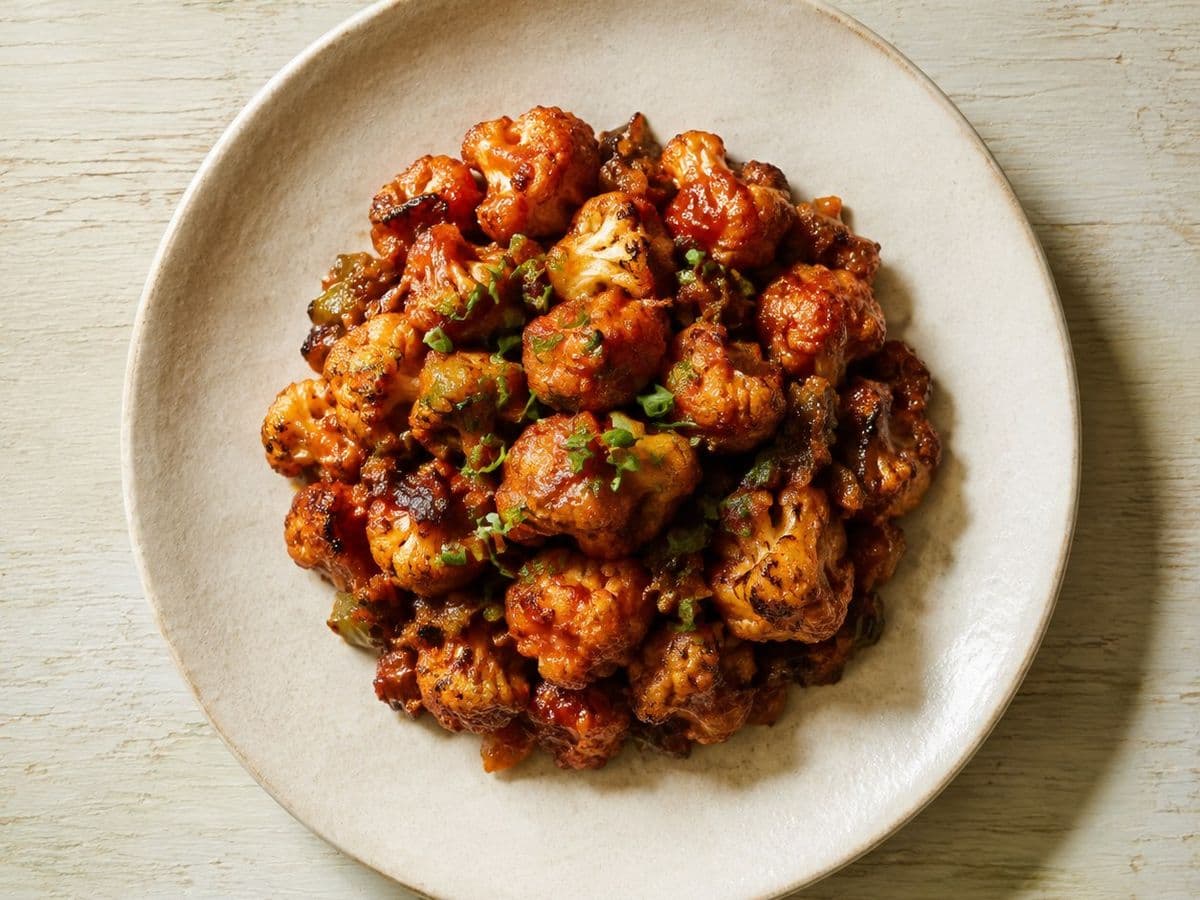
| Gobi Manchurian | vegetables | 436 kcal | 174 kcal | 60% | 7.5g |
| Butter Naan Alternative: Roti | rice | 270 kcal | 170 kcal | 37% | 6.6g |
| Egg Curry | chicken | 337 kcal | 264 kcal | 22% | 16.8g |
| Kheer | pudding | 292 kcal | 191 kcal | 35% | 12.1g |
| Gulab Jamun | pudding | 336 kcal | 137 kcal | 59% | 6.4g |
| Mango Lassi | pudding | 196 kcal | 148 kcal | 24% | 14.4g |
| Carrot Halwa | pudding | 430 kcal | 179 kcal | 58% | 10.4g |
| Chicken 65 | starters | 518 kcal | 280 kcal | 46% | 41.3g |
| Dosa | starters | 353 kcal | 243 kcal | 31% | 11.2g |
| Idli | starters | 233 kcal | 232 kcal | 0% | 16.5g |
| Coconut Chutney | starters | 159 kcal | 104 kcal | 35% | 5g |
| Aloo Paratha | rice | 482 kcal | 321 kcal | 33% | 23.1g |
| Chicken Chettinad | chicken | 477 kcal | 361 kcal | 24% | 41.8g |
| Prawn Balchao | fish | 379 kcal | 211 kcal | 44% | 31.8g |
| Baigan ka Salan | vegetables | 520 kcal | 378 kcal | 27% | 39.7g |
| Methi Murgh | chicken | 483 kcal | 377 kcal | 22% | 48.1g |
| Rajma | dal | 366 kcal | 298 kcal | 19% | 17g |
| Shahi Tukda | pudding | 408 kcal | 319 kcal | 22% | 19.7g |
The ones I wouldn't touch
Dishes drafted for this book that didn't survive. If every dish survived lightening, that chapter would be a marketing device and you should trust none of the rest. Why some dishes cannot be lightened goes through the reasoning.
Tarka Dal
Tarka dal is just red lentils boiled down until they collapse, topped with a sizzling pan of spiced ghee. That hot fat is the tarka. My editor explicitly told me not to touch the tarka. Without it, you've just got a bowl of sad yellow gruel.
Lentils are what they are. You get a solid amount of protein, but it comes firmly attached to a fair bit of starch. I can't separate the carbohydrates from the protein in a lentil, and I can't magic the fat out of the ghee.
Since I'm banned from touching the fat in the tarka, and I can't alter the fundamental nature of a lentil, I'm stuck. I could dump 500g of diced chicken breast into the pot, but that just turns it into a chicken stew. I could stir in egg whites, but that sounds absolutely disgusting.
So this one fails the test. I can't make this dish any leaner without completely ruining it. Eat the traditional version instead. It's cheap, it's filling, and it tastes unbelievable when cooked right.
Onion Bhaji
You cannot bake an onion bhaji. I know other cookery books tell you that you can, but don't believe them. A bhaji is essentially sliced onions suspended in a simple batter of gram flour, water and spices. The magic only happens when that wet mixture hits a vat of fiercely hot oil. The water in the onions violently turns to steam, the gram flour puffs up, and you've got a crispy, jagged, golden ball of joy.
If you put that exact same batter on a flat tray and stick it in the oven, it doesn't crisp. It just sits there, slowly drying out into a dusty, heavy, profoundly depressing onion biscuit that tastes faintly of raw flour. I tried doing this three different ways to cut the frying oil, and every single attempt went straight in the bin.
To make a dish leaner, you either need to add lean meat or slash the fat. Adding chicken or fish to an onion bhaji makes it a pakora, which is a completely different starter. Cutting the fat means baking it, which destroys the entire structural integrity of the food. It isn't a bhaji anymore, it's a baked onion lump.
I won't publish a recipe for a baked onion bhaji. It's an absolute insult to Indian cooking and a massive waste of your time. My whole approach is about making intelligent swaps that keep the spirit of the food alive. When a swap fundamentally ruins the dish, you have to draw a line. If you want a bhaji, go to your local restaurant, order a proper deep-fried one, eat it, and just have a slightly smaller lunch the next day. Sometimes you just have to admit defeat and respect the hot oil.
Chapati
Let's look at a chapati. It is flour, water, and a tiny smear of fat cooked on a blistering hot pan. That is the entire recipe.
To raise the protein density of a simple flatbread, I would have to start cutting the traditional atta flour with strange things like egg whites or synthetic powders. I am absolutely not doing that. If I swap the wholewheat flour for gram flour to bump the protein, I haven't made a lightened chapati, I've just made a completely different Indian bread.
If I completely cut out the tiny brush of ghee at the end, I save maybe 30 calories but entirely ruin the pliability of the bread. It turns into a dry cracker that shatters when you try to fold it. That costs you the ability to actually scoop up your dinner, which defeats the point of a flatbread.
Some things are already as elemental and lean as they can possibly be. A chapati is a carbohydrate vehicle designed for getting sauce from a plate to your mouth. You can't change it without destroying it. Leave it exactly as it is, and rely on the meat or the lentils in your curry to provide the protein.
Dhokla
You can't hack a dhokla. I spent 3 days staring at a steaming tin of gram flour trying to figure out how to force this into the rules of the book, and I've formally admitted defeat.
Dhokla is a beautiful, bouncy, steamed Gujarati sponge. It relies entirely on the precise chemical reaction between an acid, usually yoghurt or lemon juice, and a raising agent to create its trademark airy texture. The physical structure is provided entirely by gram flour, which naturally brings a decent hit of fibre and its own distinct, nutty flavour.
To change a dish for this book, I usually have two options. I can strip out heavy fats, or I can increase the meat to shift the balance. Neither works here. There's almost no fat in a traditional dhokla to begin with. It's steamed rather than fried, meaning it never touches hot oil to cook. The only oil you'll find is a tiny splash used at the very end in a hot frying pan to temper the mustard seeds, fresh green chillies and curry leaves that you pour over the top. If you remove that oil, the spices burn instantly on the bare metal and taste like bitter ash.
If I try to force a lean protein into the batter, like minced chicken or whisked egg whites, the delicate chemistry completely collapses. The sponge turns into a dense, watery hockey puck that refuses to rise. It isn't a delicate steamed starter anymore, it's a depressing poultry terrine. Nobody wants a chicken terrine that tastes of fermented lentils and mustard seed. It's an absolute culinary disaster.
You could theoretically replace the tiny pinch of sugar in the tempering liquid with an artificial sweetener, but the metallic aftertaste ruins the sweet and sour balance that makes the dish sing in the first place. That trade is absolutely not worth the sacrifice for a negligible saving. I'm not running a chemistry lab, I'm cooking food for people to actually enjoy.
Some traditional dishes are already perfectly engineered for what they are. Dhokla is light, sharp, spongy and brilliant. Fiddling with it to shave off 20 calories is exactly the kind of joyless cooking I hate. I refuse to ruin a classic just to tick a box. Eat the real thing, appreciate the incredible texture, and get your heavy meat fix from the main course.
Mint Chutney
Mint chutney is essentially a fistful of fresh leaves, a squeeze of lime juice, a green chilli and a spoonful of yoghurt blended into a bright green paste. It has virtually no calories to begin with.
Trying to strip fat or force protein into a delicate herb condiment is exactly the kind of nutritional nonsense I refuse to engage with. If I swapped the tiny amount of full-fat yoghurt for a fat-free alternative, I might technically change the numbers on paper. I could claim a massive percentage increase in protein density, but that is a completely fake win. I'd be ruining a perfectly sharp, cooling dip just to hit an arbitrary metric for a side dish that barely registers on your daily intake anyway.
I am not pouring protein powder into a bowl of blended coriander. I am not folding chicken breast into a liquid garnish. Chutney exists to cut through the rich, heavy spices of a main course, providing a sharp shock of acidity and freshness. Messing with that balance to save 12 calories is an absolute waste of time.
Eat the traditional version exactly as it is. Throw your mint and coriander in a blender with some green chillies, garlic, a chunk of ginger, salt, lime juice and a dollop of proper yoghurt. It costs you absolutely nothing nutritionally and tastes brilliant.
Where the numbers come from
- FoodData Central, SR Legacy Release (April 2018). U.S. Department of Agriculture, Agricultural Research Service. Public domain (U.S. Government work).
- McCance & Widdowson's Composition of Foods Integrated Dataset (CoFID) 2021. Public Health England / Office for Health Improvement and Disparities. Open Government Licence v3.0.
- FoodData Central, Branded Foods (October 2024 release). U.S. Department of Agriculture, Agricultural Research Service. Public domain (U.S. Government work).
Retrieved 2026-08-21. Nothing in these books is dietary or medical advice. Danny Vale is a cook.